
How FISH spends Donor Dollars
Thinking about contributing? This page may help you decide.
Since 2022, contributions from a variety of sources have accounted for 64% of FISH’s operating income. The donors include individuals, businesses, local family foundations, civic groups, nonprofits and churches.
Grants from large foundations and agencies, including the United Way, contribute 35%. The federal government’s Emergency Food and Shelter Program managed by FEMA accounts for the remaining 1%.
On this page you can review average spending over the past four years. You also will see the number of people FISH has helped each year since 2016 and review our guidelines for helping our neighbors in need.
Have a question or comment?
FISH board members are eager to answer questions you may have about finances, policies and practices. Also welcome are comments or opinions about nonprofit’s work in the community. You may write an email by clicking the link here.
FISH's Spending Pie
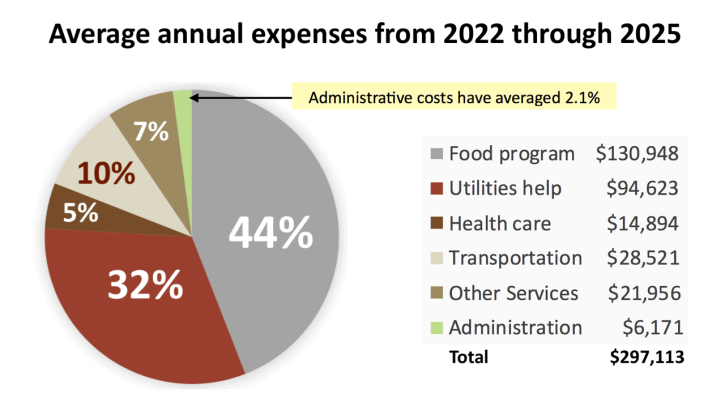
For the past four years, food and utilities programs have consumed 75 cents of every dollar FISH spends. In 2025, FISH’s portion of food costs were $196,000 — 40% more than in 2024. We pay for meat, milk, eggs and other essentials. Our 18 partner churches and regional nonprofit food banks also contribute food. FISH’s utilities program helps people with shutoff notices for water or electricity. We also buy propane that FISH clients use for heating and cooking. Other services include helping people who need auto parts, footwear or work clothes they need for a new job. We also buy children’s shoes, monthly bus passes, birth certificates, prescriptions and more. certificates, prescriptions and more.
Thousands helped every year

FISH churches filled a record number of orders in 2025 — 8,604 households. They were occupied by 34,665 recipients — people who obtained food one or more times. Clients, unique individuals, totaled 6,791 from 1,951 households. Among them were 2,519 children. Lower household counts from 2020 to 2022 were during the pandemic.

When calls for help spike, FISH responds. In 2022, volunteers okayed 3,125 requests for help. Among them were 1,181 households with large utility bills caused by the cessation of Covid-19 rules prohibiting utilities from shutting off water and electricity. In normal times, requests for help fluctuate. National and local economic conditions tend to drive demand.
Policies and practices
Callers help pay for some services
We have annual dollar limits on every nonfood service we provide. That requires many callers to pay a portion of what they need. Overdue water or power bills must be reduced to $100 or less before FISH will pay the balance. Other limits are $100 for auto parts, $50 for gas, and $40 for attire required for a job.
Limits on some services
FISH services have frequency limits for individuals. Some examples:
• Help with overdue water and power bills is limited to once each calendar year.
• The annual limit for propane is $120, at a maximum of $30 per time and only in the six coldest months.
• Auto parts and auto gas, both in high demand, have a once-a-year limit.
We track food and service usage
All requests volunteers approve are recorded in Excel files that are imported into databases – one for food, one for other services.
Volunteers who help with nonfood emergencies have access to an alphabetized list of clients updated monthly. The list shows the cost and service each received in the calendar year. A person who has hit an annual maximum is denied further help with that specific service.
Volunteers have discretion
Volunteers are free to decide if a special situation warrants waiving policy guidelines. That can mean exceeding a dollar limit or helping with an unusual request.
Examples include helping a daughter pay for her mother’s cremation, renting a storage unit for a single mother who was evicted, paying a $168 towing bill for the owner a car that was impounded after being stolen, and buying a $21 bike lock for a homeless man.